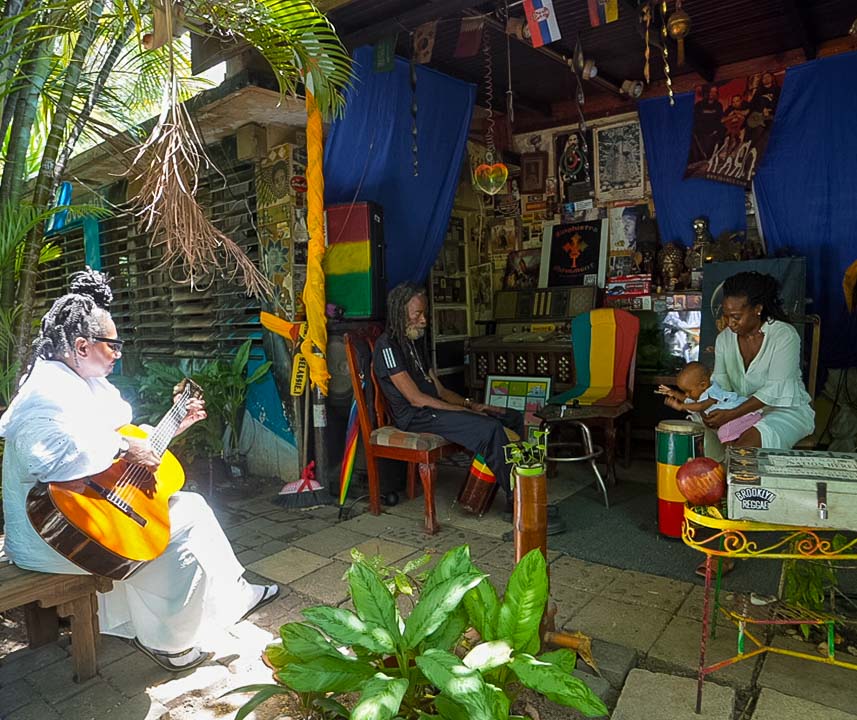
Jamming Inna Di Yard: Soulful Sessions with Earl “Chinna” Smith & Melchizedek
The evening air in St. Andrew carries a distinct coolness as it rolls off the peaks of the Blue Mountains, settling into the valley spaces of Kingston. It smells of woodsmoke, wet earth, and the faint, sweet perfume of crushed mint and cerasee. For those who navigate Jamaica through the air-conditioned corridors of all-inclusive resorts and tour buses, this version of the island does not exist. But if you follow the sound of an acoustic guitar echoing past zinc fences and overhanging mango limbs, you find yourself exactly where you need to be. Feet planted firmly in the dirt. No stage, no velvet ropes, no strobe lights. Welcome to St. Andrew Park—the legendary yard of Earl “Chinna” Smith. This is the home of **Inna Di Yard**, a living, breathing movement that remains the heartbeat of **Jamaican roots music**. On this specific evening, captured in a moment of pure creative synchronicity, the yard became a sanctuary for a masterclass in musical healing featuring Chinna himself and the raw, resonant talent of artist Melchizedek. The High Priest of the Rhythm Guitar ------------------------------------ To understand the weight of the air in this space, one must understand the man holding the instrument. Earl “Chinna” Smith is not merely a musician; he is a living archive of reggae history. Dubbed the "High Priest of Reggae Guitar," Chinna’s distinct, percussive "skank" and fluid lead lines have shaped the discographies of Bob Marley and the Wailers, Burning Spear, Dennis Brown, and the Melodians. He has played on more hit records than nearly any other guitarist in the history of the genre. Yet, his greatest contribution to the preservation of **authentic Jamaica** might just be the sanctuary he created right on his own doorstep. Decades ago, Chinna stripped away the commercial sheen of modern studio tracking and brought the music back to its foundational element: the communal gathering. > “Music is a spiritual thing,” Chinna often reminds those who sit at his feet. “It grow inna di earth, it don't grow inna di machine.” Grounded in the Dirt: The Meaning of Inna Di Yard ------------------------------------------------- In Jamaica, the "yard" is everything. It is the communal outdoor living space where food is shared, arguments are settled, and life is lived beneath the open sky. When turned into a creative space, _Inna Di Yard_ becomes an egalitarian arena. There is no distinction between the performer and the observer. As the golden hour bleeds into twilight, a tight circle forms. Elders sit on wooden benches, their faces etched with the lines of a lifetime spent in the music. Younger roots revivalists stand shoulder-to-shoulder with international travelers who wandered into the space looking for something real. The session begins without a cue. Chinna’s fingers dance across the fretboard of his weathered acoustic guitar. The sound is woody, bright, and deeply percussive. He isn't just playing chords; he is laying down a foundation that commands the room to quiet down. A hand-drum—a NyabinghiNyabinghiThe oldest orthodox mansion of Rastafari, featuring sacred drumming, chanting, and spiritual reasoning gatherings. repeater—joins in, mimicking a steady, primordial heartbeat: _one-two, boom-point._ Melchizedek: Channeling the Ancient Frequency --------------------------------------------- Into this sonic tapestry steps Melchizedek (@smithmelchizedek). The energy shifts instantly. There is an intensity to his posture, a man completely surrendered to the frequency of the room. When he opens his mouth to sing, the vocal delivery isn't tailored for a radio hook; it is a raw, impassioned plea that feels pulled directly from the soil. Melchizedek’s voice possesses that rare, textured grit reminiscent of the classic 1970s roots era—evoking the spiritual urgency of a young Winston Rodney or Yami Bolo. He locks eyes with Chinna, reading the master guitarist's subtle chord changes like a map. The lyrics flow freely, a mix of spontaneous chanting and structured poetry addressing justice, repatriation, and spiritual endurance. As Melchizedek reaches a crescendo, gesturing to the heavens while his voice echoes off the concrete walls of the yard, you can feel a collective goosebump ripple through the small crowd. It is a reminder that reggae music, at its core, is a liturgical experience. It is a balm for the weary and a fire for the complacent. Escaping the Tourist Bubble with WatchRasta ------------------------------------------- Moments like this are exactly why **watchRasta** exists. The philosophy behind our platform is built on a simple premise: Jamaica's truest wealth is not found in commercialized luxury, but in its unfiltered cultural lineage. Too often, visitors see a sanitized version of the island—a caricature of paradise designed to be consumed rather than experienced. By documenting and sharing these intimate yard sessions, watchRasta aims to bridge the gap between global seekers and the authentic custodians of Rastafari and reggae culture. Sitting in the yard with Chinna Smith and Melchizedek reminds us that the music belongs to the community. When a guest from the watchRasta family sits in this circle, they aren't consumers; they are witnesses to a sacred preservation project. Why the Acoustic Frequency Matters ---------------------------------- In an era dominated by computerized beats and digital pitch-correction, the acoustic sessions of Inna Di Yard offer a vital course correction. You hear the scrape of fingers against steel strings. You hear the natural intake of breath before a singer delivers a heavy line. If someone misses a beat, the circle laughs, adjusts, and keeps rolling. It is beautiful because it is imperfect. It is powerful because it is human. When the final chord fades into the night and the crickets take over the background track, no one applauds immediately. Instead, there is a heavy, reverent silence—a collective _Selah_. These sessions remind us that to truly experience Jamaica, you have to be willing to slow down, leave the resort gates behind, and sit in the dirt where the roots are still fed. It is within these quiet, unadvertised spaces that the true soul of the island continues to sing. _To discover more hidden spaces, cultural links, and authentic roots sessions across the island, stay locked to_ **_watchrasta.tv_**_—where the culture lives._